

Josep Pascó i Mensa
Sant Feliu de Llobregat (1855) - Barcelona (1910)
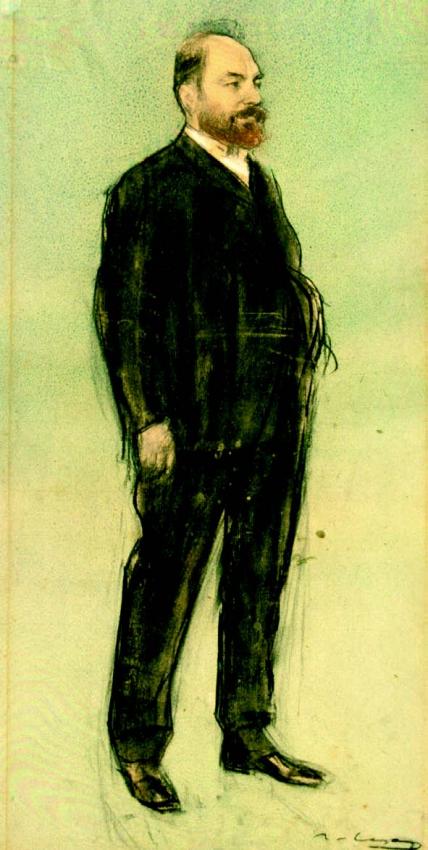
This versatile artist studied at La Llotja, the Barcelona
School of Fine Arts. At first he devoted himself to painting, particularly landscapes, but he soon shifted his interest towards decoration and illustration.
As a teenager was already painting scenery for amateur theatre groups and worked in the stage designer Josep Planella's workshop where he was given lessons by Simó Gòmez. He worked as a stage designer in Barcelona, Madrid and Mexico. He showed his work at many exhibitions and won several medals, including the gold medal at the Barcelona Universal Exhibition in 1888, and acquired a big reputation.
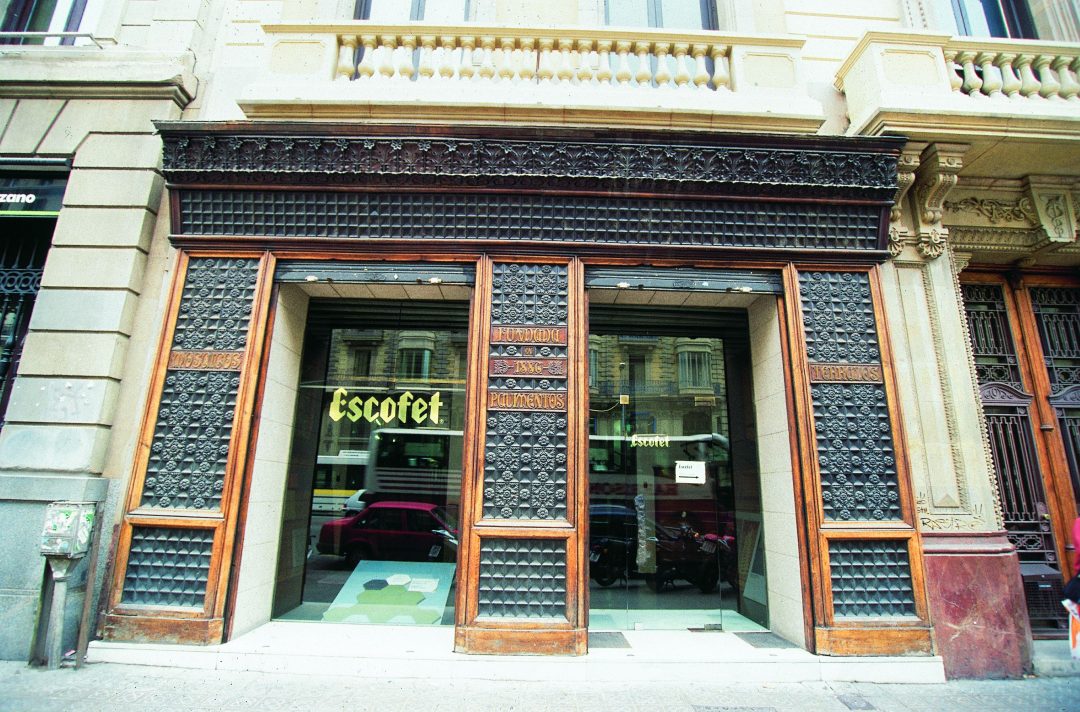
His work features a high degree of decorativism, especially in the sinuosity of its lines and the floral ornamentation accompanying the central illustration. Some of his best-known works in Barcelona are the design for the entrance door to Casa Escofet (Ronda de Sant Pere, 20); the entire interior decoration of Casa Casas-Carbó (1894; Passeig de Gràcia, 96), owned by the painter R. Casas and designed by the architect A. Rovira, and the designs for the "goldfish bowl" of the Cercle del Liceu (El Liceu Circle, Gran Teatre del Liceu, Rambla, 51-65).
Another field in which he also stood out as a representative of the aestheticist and decorativist tendency of Modernisme was the art of bookmaking. He designed bindings for the Editorial Montaner i Simón publishing house (1881-1886; Aragó, 255; currently home to the Antoni Tàpies Foundation) and for the company belonging to E. Miralles.
He was editor and illustrator of the magazine Hispania and published drawings in the magazine La Ilustració Catalana under the pseudonym of "Brisa".
He taught at the Barcelona Higher School of Arts and Industries.
Principal works
Get the Guidebook of Barcelona Modernisme Route
The Barcelona Modernisme Route is an itinerary through the Barcelona of Gaudí, Domènech i Montaner and Puig i Cadafalch, who, together with other architects, made Barcelona the great capital of Catalan Art Nouveau. With this route you can discover impressive palaces, amazing houses, the temple that is symbol of the city and an immense hospital, as well as more popular and everyday works such as pharmacies, shops, shops, lanterns or banks. Modernisme works that show that Art Nouveau took root in Barcelona and even today is still a living art, a lived art.
The Guidebook of Barcelona Modernisme Route can be acquired in our centers of Modernisme.