

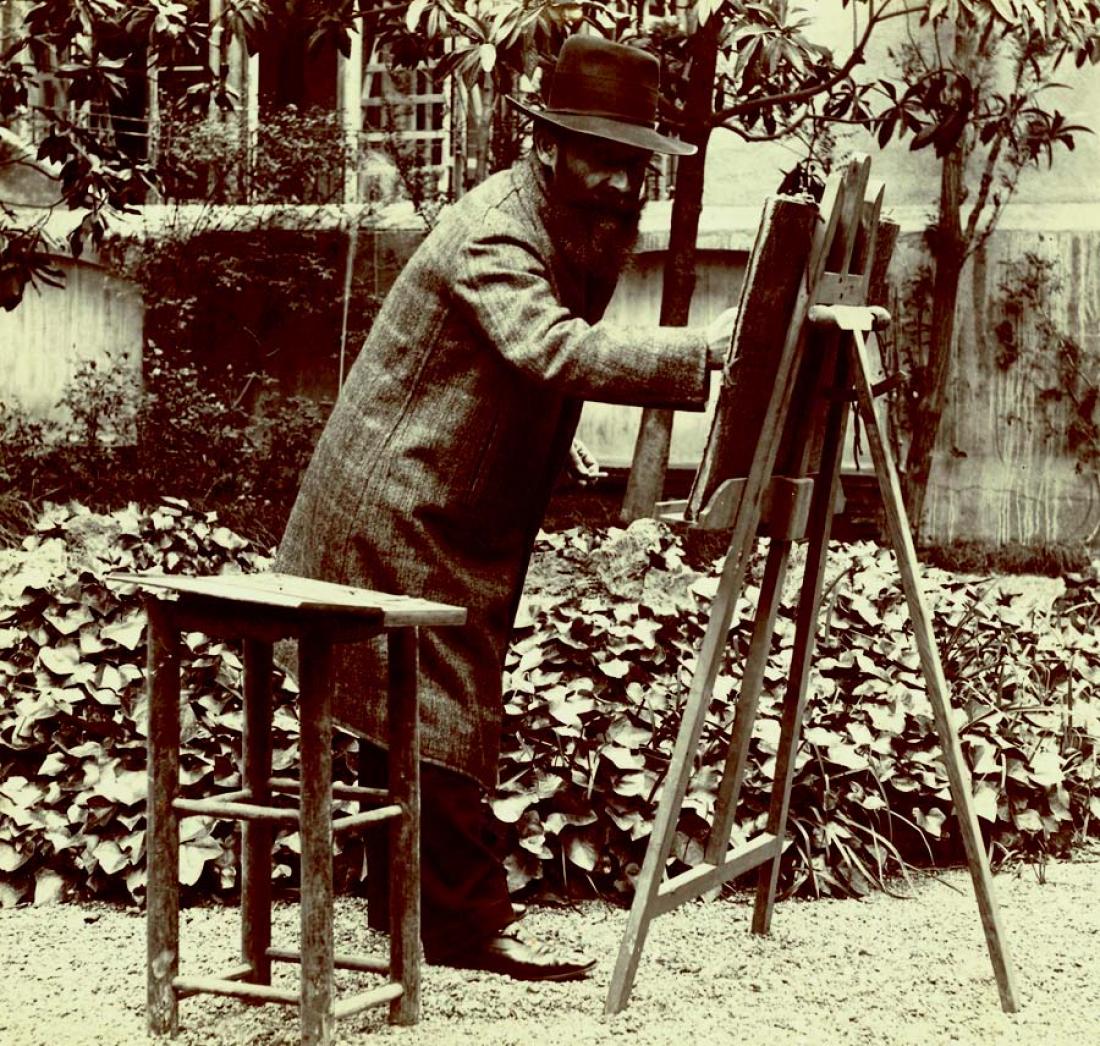
He started out studying medicine, but he quickly gave this up to go to La Llotja, the Barcelona School of Fine Arts. He soon began to take part in several exhibitions and acquired such status that at the Barcelona Universal Exhibition in 1888 he was already a member of the art jury.
In 1889 he went to further his education in Paris where he met the painters R. Casas and S. Rusiñol, and came into contact with the French Impressionists. A year later he held his first exhibition at Sala Parés (Petritxol, 5). He was one of the regulars at the Quatre Gats café (Montsió, 3 bis) and the Sitges Modernista Festivals, and was linked to the L'Avenç group.
His early works are in the Realist tradition and of a markedly decorative character, a feature for which he was criticised at his first individual exhibitions. He soon evolved towards landscape painting with a more modern atmosphere and use of colours (Setembre [September], 1896; MNAC collection). His landscapes of Majorca, where he was the director of the School of Fine Arts of Palma and Catalonia, are highly characteristic of his work.
Although he was a Modernista, especially through being connected to all the events of the movement, he displayed two sides in his paintings, one closer to traditional styles designed to please a certain rather conservative public, and another more modern and daring side comprising landscapes of all the countries in which he made brief stays (Italy, Argentina, the United States and France).
Principal works
Sorry for the inconvenience, but we do not have any work for this author.
Get the Guidebook of Barcelona Modernisme Route
The Barcelona Modernisme Route is an itinerary through the Barcelona of Gaudí, Domènech i Montaner and Puig i Cadafalch, who, together with other architects, made Barcelona the great capital of Catalan Art Nouveau. With this route you can discover impressive palaces, amazing houses, the temple that is symbol of the city and an immense hospital, as well as more popular and everyday works such as pharmacies, shops, shops, lanterns or banks. Modernisme works that show that Art Nouveau took root in Barcelona and even today is still a living art, a lived art.
The Guidebook of Barcelona Modernisme Route can be acquired in our centers of Modernisme.
