

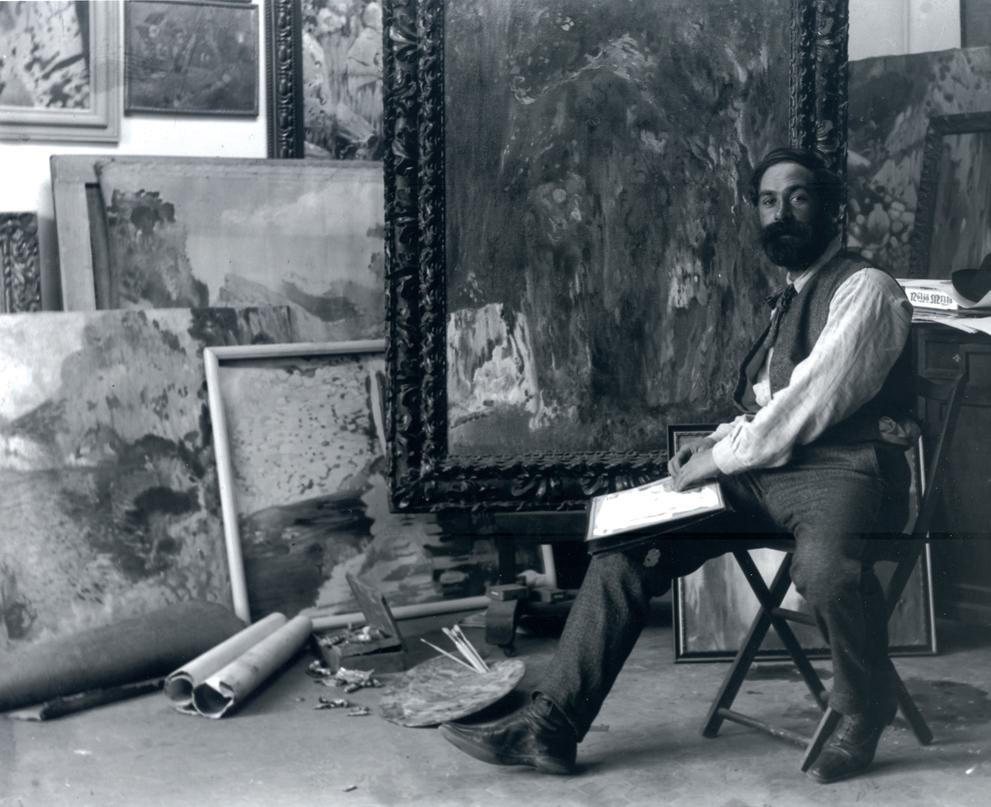
He began his training at the academy run by L. Graner, where he coincided with I. Nonell, whom he already knew from school. After a short while he enrolled at La Llotja, the Barcelona School of Fine Arts, and was one of the members of the group of painters known as La Colla del Safrà (The Saffron Gang). When Els Quatre Gats (Montsió, 3 bis) opened he became one of the regulars at the meetings and took part in the first exhibition of drawings held there. During those early years, up until 1901, he contributed drawings to magazines such as L'Esquella de la Torratxa and Hispania. That was the year he held his first individual exhibition at Sala Parés (Petritxol, 5). His work displays a highly personal style in which his treatment of colour and his fluid brushstrokes are noticeable features, as can be seen, for example, in La catedral dels pobres (The Poor People's Cathedral, 1898; MNAC collection).
Together with the painter S. Rusiñol he lived in Majorca from 1899 to 1903, which marked a change in his production. From that time on his landscapes became more mature and he achieved great deal of popularity and success. His works from this period include Roc de l'estany (Rock of the Pool, 1903; MNAC collection) and La cala encantada (The Enchanted Cove, 1901; MNAC collection). Shortly after returning to Barcelona he went away again, this time to Tarragona, where he stayed until 1911, painting mainly landscapes, such as Maspujols, Poble escalonat (Terraced Village, 1909; MNAC collection) and l'Aleixar, La bassa nova (The New Pool, 1907-1913; MNAC collection).
Apart from painting, he also worked at the beginning of his career on stained glass windows for Casa Rigalt, Granell i Cia, for which he made two triptychs and religious pieces (Gorg Blau [Blue Ravine]; MNAC collection) and some others in which his quality as a painter can be appreciated in the use he makes, for example, of grisaille.
Principal works
Sorry for the inconvenience, but we do not have any work for this author.
Get the Guidebook of Barcelona Modernisme Route
The Barcelona Modernisme Route is an itinerary through the Barcelona of Gaudí, Domènech i Montaner and Puig i Cadafalch, who, together with other architects, made Barcelona the great capital of Catalan Art Nouveau. With this route you can discover impressive palaces, amazing houses, the temple that is symbol of the city and an immense hospital, as well as more popular and everyday works such as pharmacies, shops, shops, lanterns or banks. Modernisme works that show that Art Nouveau took root in Barcelona and even today is still a living art, a lived art.
The Guidebook of Barcelona Modernisme Route can be acquired in our centers of Modernisme.
