

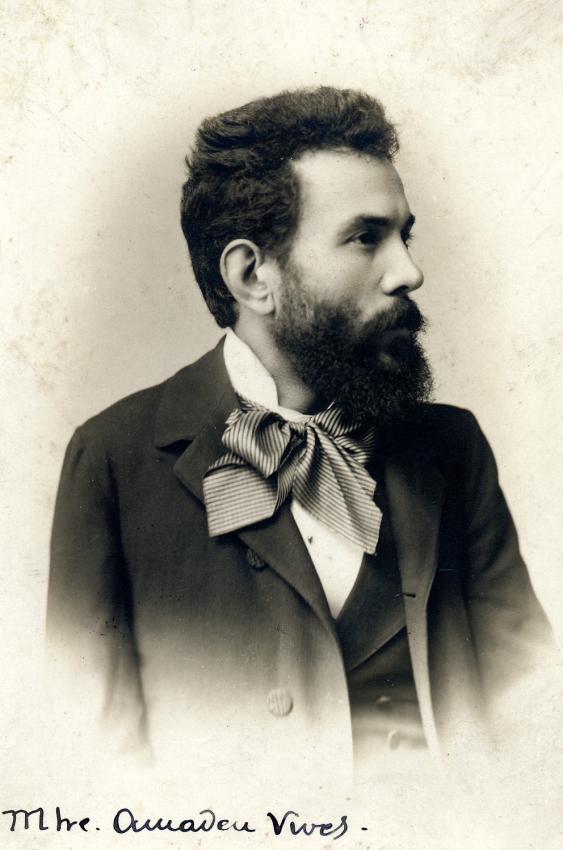
He began studying music, especially the piano, at a very early age in Barcelona, where he had moved with his family.
Shortly after coming to the city he met L. Millet, with whom he would eventually found the Orfeó Català choral society in 1891. From that time on he harmonised various Catalan popular songs such as Els Segadors (The Reapers, the Catalan national anthem) and L´Emigrant (The Emigrant). His musical production made him an extremely popular and successful figure, as well as a prominent intellectual, among his contemporaries.
He was a regular participant in the literary and artistic discussions in the cafés of Barcelona where he met Picasso, I. Nonell, R. Casas and E. Morera, among others. He also mixed with other representatives of the Modernista current, such as J. Puig i Cadafalch and L. Domènech i Montaner.
In 1897 he moved to Madrid, where he pursued most of his career, but he never severed his links with Barcelona. He wrote and staged several highly successful operas and zarzuelas (light operas), such as Lola Montes (1902) and Bohemios (Bohemians, 1904). After a while he became the impresario of three theatres in Madrid ? the Zarzuela, the Cómico and the Eslava ? where he premiered his works. From 1922 onwards he combined his work as a composer with teaching at the Madrid Conservatory of Music. In subsequent years he undertook a tour of South America, which was a huge success.
When he returned, first to Barcelona and then Madrid, his music became more intimate and more Mediterranean, in contrast with what he had done until then, which was in a more popular and dramatic style.
Principal works
Sorry for the inconvenience, but we do not have any work for this author.
Get the Guidebook of Barcelona Modernisme Route
The Barcelona Modernisme Route is an itinerary through the Barcelona of Gaudí, Domènech i Montaner and Puig i Cadafalch, who, together with other architects, made Barcelona the great capital of Catalan Art Nouveau. With this route you can discover impressive palaces, amazing houses, the temple that is symbol of the city and an immense hospital, as well as more popular and everyday works such as pharmacies, shops, shops, lanterns or banks. Modernisme works that show that Art Nouveau took root in Barcelona and even today is still a living art, a lived art.
The Guidebook of Barcelona Modernisme Route can be acquired in our centers of Modernisme.