

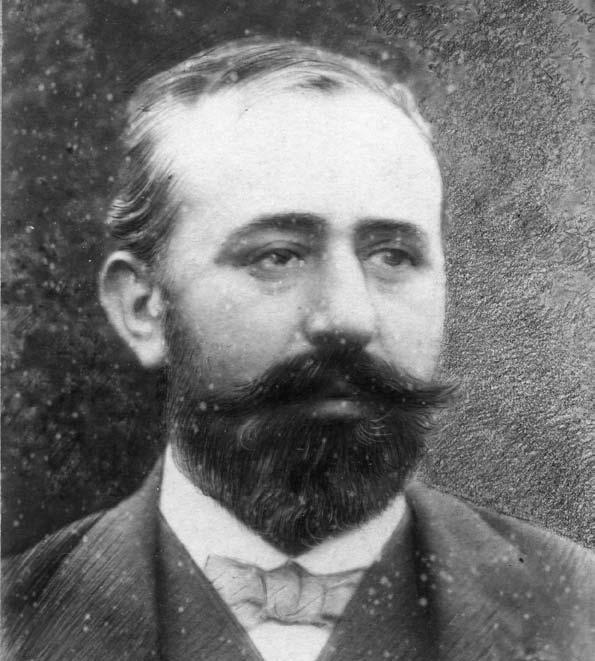
He studied under L. Domènech i Montaner at the Barcelona School of Architecture, at which he was later a lecturer.
He took part in two projects for the 1888 Barcelona Universal Exhibition, the Hotel Internacional (Marquès d'Argentera, 1885; no longer in existence) and the Castell dels Tres Dragons (Castle of the Three Dragons, Parc de la Ciutadella; currently the Natural Science Museum), where his role was mainly in the application of the wrought iron and the ceramic decoration.
At the start of his career he displayed a Neo-Gothic tendency, which is evident in works such as the La Riba family vault (1891; South-West Cemetery on Montjuïc, Mare de Déu del Port, 56-58), on which there is a certain profusion of floral ornamentation. However, it is not until the end of his career that elements of the Modernista style can be glimpsed.
His architecture is characterised by the abundant use of ceramic tiles and mouldings. Indeed, he was a great collector of these two kinds of objects. He also built up an extensive collection of photographs of monuments in Barcelona, together with his friend A. Font i Gumà, also an architect. They both did designs reproducing Gothic models which were then made by the Pujol i Bausis factory and Casa Escofet.
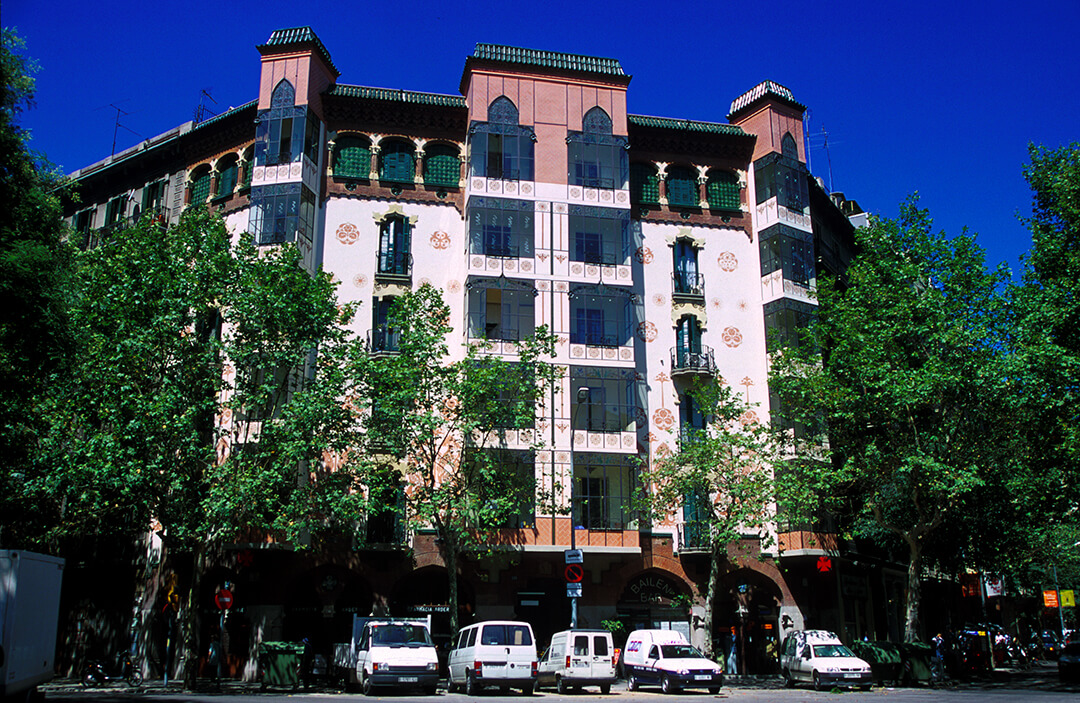
Although there is some individual work of his in Barcelona, such as Casa Llopis i Bofill (1902; València, 339), he mainly collaborated with other architects, taking part in the wrought iron and ceramic work.
He designed decorative wallpaper and patented it under the name of "Pegamoid".
His involvement in politics was linked to his presidency of the Unió Catalanista (Catalanist Union) and he became vice-chairperson of the Ateneu Barcelonès (Barcelona Athenaeum).
Principal works
Get the Guidebook of Barcelona Modernisme Route
The Barcelona Modernisme Route is an itinerary through the Barcelona of Gaudí, Domènech i Montaner and Puig i Cadafalch, who, together with other architects, made Barcelona the great capital of Catalan Art Nouveau. With this route you can discover impressive palaces, amazing houses, the temple that is symbol of the city and an immense hospital, as well as more popular and everyday works such as pharmacies, shops, shops, lanterns or banks. Modernisme works that show that Art Nouveau took root in Barcelona and even today is still a living art, a lived art.
The Guidebook of Barcelona Modernisme Route can be acquired in our centers of Modernisme.