

Eduard Ferrés i Puig
Vilassar de Mar (1872) - Barcelona (1928)
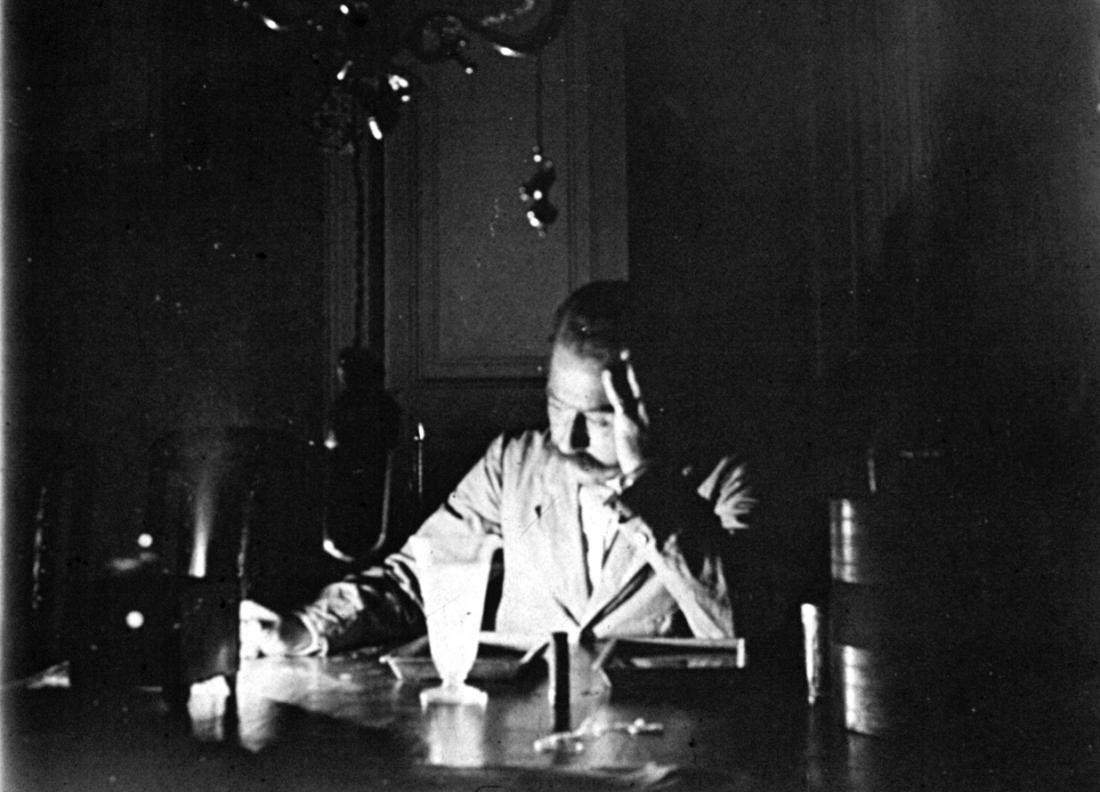
A member of a family of captains and sailors, he was educated at the Merchant Navy School in Vilassar de Mar, which played a key role in helping him to discover the relations between form and technique which he was to utilise in his future works. In 1891 he left Vilassar to go to the Barcelona School of Architecture, where he qualified as an architect in 1897.
He was a teacher of drawing and the director of the School of Arts and Crafts in Mataró. In his drawings he dealt extensively with the subjects of bull-fighting and everyday life, and was a regular contributor to the magazine Cu-cut!, for which he drew cartoons under the nom de plume of "Feréstech".
He worked all over Catalonia, including Mataró and Premià de Dalt, towns where he was the municipal architect, and Canet de Mar, where he made the cemetery. In 1902 he obtained the post of municipal architect in Vilassar de Mar, where a large part of his work is to be found, although he also designed and constructed buildings in Barcelona, such as the Hotel Ritz (1915; Gran Via de les Corts Catalanes, 664 - 668; now Hotel Palace), for the hotel developer Marquet, for whom he did other works, and Can Damians (El Siglo department store, 1917; Pelai, 54; now a C+A store). During his professional career he worked with architects such as L. Domènech i Montaner, J. Puig i Cadafalch and E. Sagnier, and with other artists belonging to the movement, such as G. Cornet and M. Utrillo. His customers were the intellectual aristocracy of the time who trusted his qualities as an architect.
He travelled a great deal throughout his life and left an extensive photographic record of his journeys, as he was a keen amateur photographer.
Principal works
Sorry for the inconvenience, but we do not have any work for this author.
Get the Guidebook of Barcelona Modernisme Route
The Barcelona Modernisme Route is an itinerary through the Barcelona of Gaudí, Domènech i Montaner and Puig i Cadafalch, who, together with other architects, made Barcelona the great capital of Catalan Art Nouveau. With this route you can discover impressive palaces, amazing houses, the temple that is symbol of the city and an immense hospital, as well as more popular and everyday works such as pharmacies, shops, shops, lanterns or banks. Modernisme works that show that Art Nouveau took root in Barcelona and even today is still a living art, a lived art.
The Guidebook of Barcelona Modernisme Route can be acquired in our centers of Modernisme.