

Enric Clarasó i Daudí
Sant Feliu del Racó (1857) - Barcelona (1941)
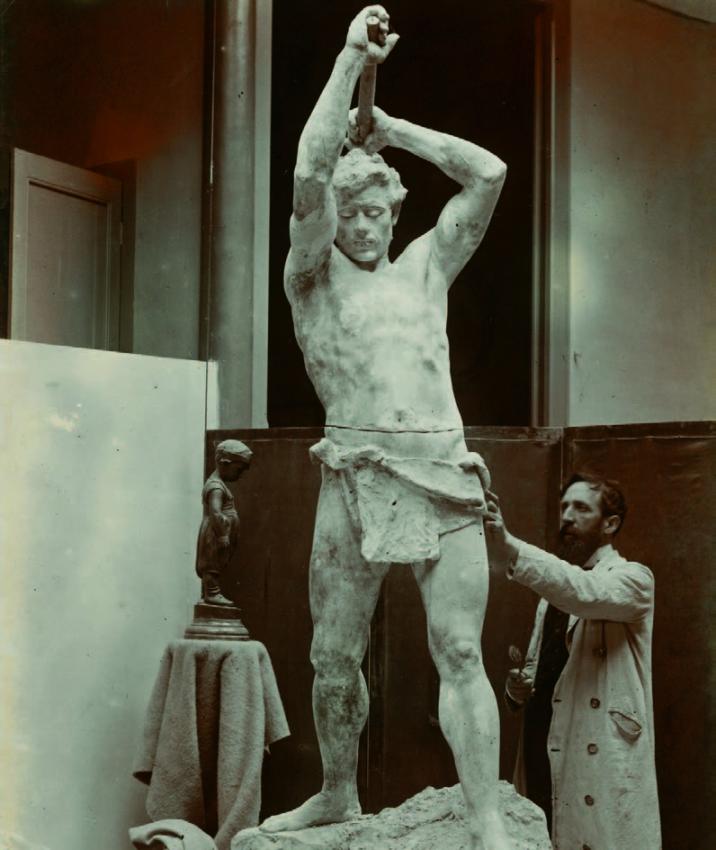
He trained at La Llotja, the Barcelona School of Fine Arts, where he was a pupil of Joan Roig. He soon set up his own studio, which became a meeting place for Modernista artists and friends of his such as R. Casas and S. Rusiñol, with whom he exhibited.
In 1889, after collaborating in the Barcelona Universal Exhibition, he went to Paris to further his studies with the sculptor Henri Chapu and at the Académie Julian.
His sculptures include some that are rooted in a certain academicism, whereas others are characteristic of Modernisme, especially the funereal monuments, which contain a large number of nude female figures, which usually have melancholy faces and are shown in forlorn postures, such as Eva (Eve, 1904; now part of the MNAC collection). He also made sculptures dealing with more social subjects.
He himself picked out Memento homo! (1900; South-West Cemetery, on Montjuïc, Mare de Déu del Port, 56-58) as his best work.
Principal works
Sorry for the inconvenience, but we do not have any work for this author.
Get the Guidebook of Barcelona Modernisme Route
The Barcelona Modernisme Route is an itinerary through the Barcelona of Gaudí, Domènech i Montaner and Puig i Cadafalch, who, together with other architects, made Barcelona the great capital of Catalan Art Nouveau. With this route you can discover impressive palaces, amazing houses, the temple that is symbol of the city and an immense hospital, as well as more popular and everyday works such as pharmacies, shops, shops, lanterns or banks. Modernisme works that show that Art Nouveau took root in Barcelona and even today is still a living art, a lived art.
The Guidebook of Barcelona Modernisme Route can be acquired in our centers of Modernisme.