

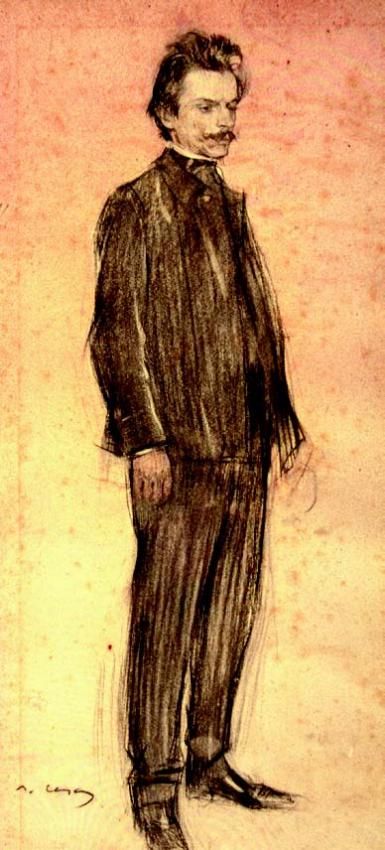
He received his musical training in Córdoba (Argentina), where his family had moved in 1875. Before returning to Barcelona in 1883, he was commissioned to do some work for the Argentinean government. In Barcelona he continued studying piano with Carles Vidiella and composition with F. Pedrell, and struck up a good friendship with the musician I. Albéniz.
He later went to live in Brussels where he continued studying at the conservatory and came into contact with Franco-Belgian musicians who exerted a strong influence on his professional development and with whom he remained in continuous touch. In 1890 he settled for good in Barcelona, where he became intensely active and soon established himself as a representative of the Modernista musical current. He was involved in the activities of the intellectual groups of the time, set to music works by S. Rusiñol and Àngel Guimerà, and composed an opera, La fada (The Fairy) for the Fourth Sitges Modernista Festival in 1897. In 1895 he founded the Catalunya Nova choir and reclaimed and harmonised many Catalan popular songs, which were published in L'Avenç. He also tried to create a Catalan opera but the attempt he made with his Teatre Líric Català (Catalan Lyrical Theatre) was not very successful in attracting an audience.
All the initiatives he took have led to his efforts to create a nationalist awareness in the musical sphere being regarded as extremely valuable.
He worked as a teacher and became a great educator.
Principal works
Sorry for the inconvenience, but we do not have any work for this author.
Get the Guidebook of Barcelona Modernisme Route
The Barcelona Modernisme Route is an itinerary through the Barcelona of Gaudí, Domènech i Montaner and Puig i Cadafalch, who, together with other architects, made Barcelona the great capital of Catalan Art Nouveau. With this route you can discover impressive palaces, amazing houses, the temple that is symbol of the city and an immense hospital, as well as more popular and everyday works such as pharmacies, shops, shops, lanterns or banks. Modernisme works that show that Art Nouveau took root in Barcelona and even today is still a living art, a lived art.
The Guidebook of Barcelona Modernisme Route can be acquired in our centers of Modernisme.