

Eusebi Güell i Bacigalupi
Barcelona (1846) - (1918)
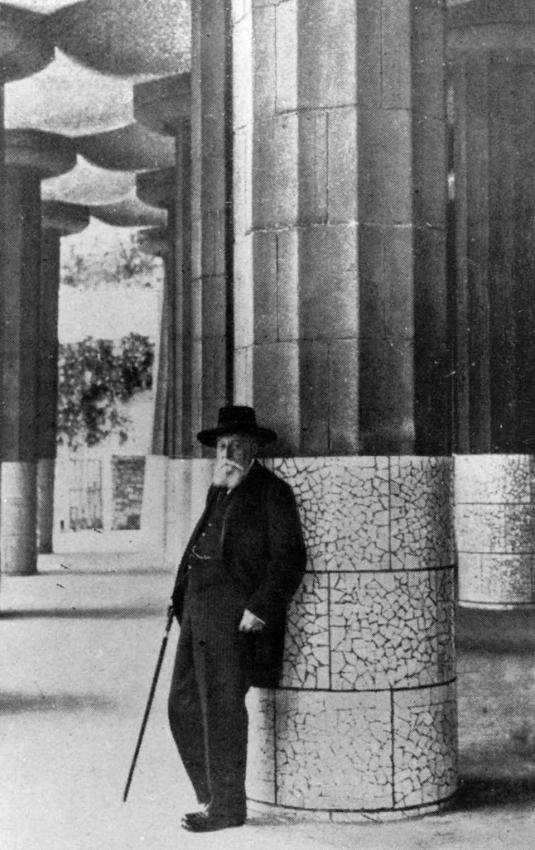
He studied law, economics and sciences in Barcelona, France and Britain, and, as soon as he had completed his education, started working in the family businesses.
As an enterprising businessman he set up various companies and factories and made a large amount of money from trade with Cuba. He was the manager of the Caixa d'Estalvis i Mont de Pietat de Barcelona (Barcelona Savings Bank and Mutual Benefit Fund) and founded the Asland cement company, among others.
He was very involved with Catalan politics as a Barcelona city councillor, first, and later as a provincial deputy. He was also very active in the world of culture: he was chairperson of the Catalan Centre and the Jocs Florals (Poetry Competitions) of Barcelona.
In 1871 he married Isabel López, daughter of the marquis of Comillas, which allowed him to enter the latter's family firms, and was to help A. Gaudí by giving him new commissions.
He first came across Gaudí's work at the 1878 Universal Exhibition in Paris, where the architect had made the display cabinets for a glove manufacturer, and from that moment on he decided to become the young architect's patron. Thereafter A. Gaudí became the Güell family's architect and they commissioned him to construct Palau Güell (1885-1889; Nou de la Rambla, 3-5) a corduroy factory, known as Colònia Güell (1890; Claudi Güell, s/n, Santa Coloma de Cervelló) and Park Güell (1900-1914), among other things.
Principal works
Sorry for the inconvenience, but we do not have any work for this author.
Get the Guidebook of Barcelona Modernisme Route
The Barcelona Modernisme Route is an itinerary through the Barcelona of Gaudí, Domènech i Montaner and Puig i Cadafalch, who, together with other architects, made Barcelona the great capital of Catalan Art Nouveau. With this route you can discover impressive palaces, amazing houses, the temple that is symbol of the city and an immense hospital, as well as more popular and everyday works such as pharmacies, shops, shops, lanterns or banks. Modernisme works that show that Art Nouveau took root in Barcelona and even today is still a living art, a lived art.
The Guidebook of Barcelona Modernisme Route can be acquired in our centers of Modernisme.