

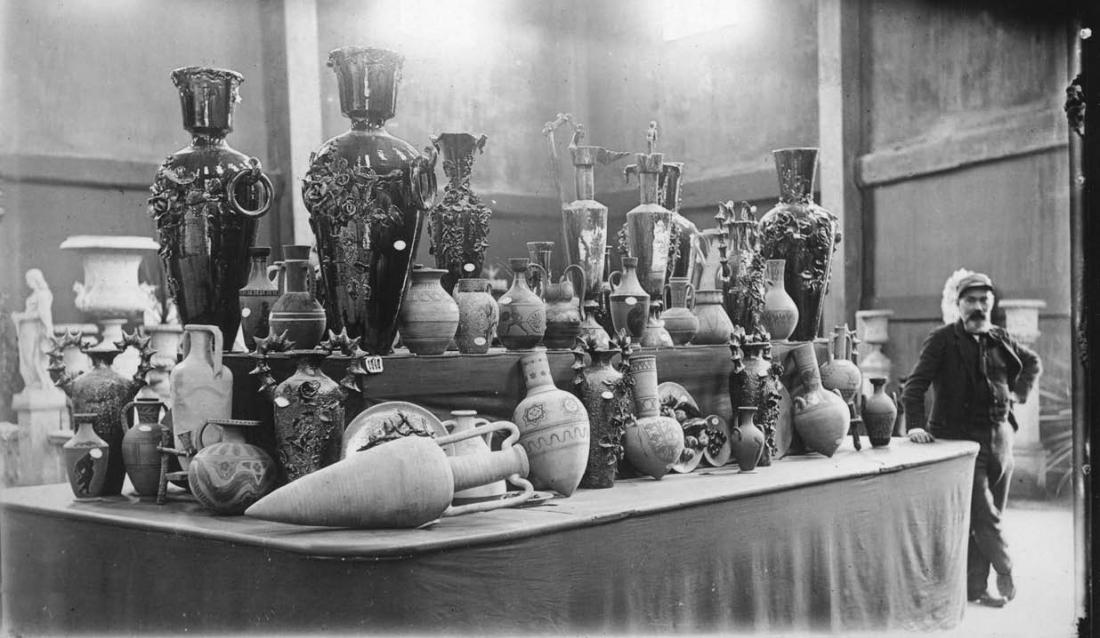
He started out in the world of ceramics in his father's workshop in Sabadell and perfected his technique in Mataró and Thuir. For various reasons he spent some time in Coimbra, a major ceramics industry centre, before going to work in Muel and Manises. In 1876 he returned to Sabadell having acquired a large fund of experience which he put to use in his father's workshop and in his work as a theoretician. He took part in literary and political discussions, and became an active figure in the social and cultural fields. An example of this activity is his involvement, as a co-founder, in the Sabadell Academy of Fine Arts and the setting up of the first Faianç Català (Catalan Faïence) in Sabadell in 1897. In 1901, together with his nephew Santiago Segura, he set up a second Faianç Català in Barcelona (Gran Via de les Corts Catalanes, 615; no longer in existence), which played a key part in the Noucentista ("1900-ist", a term coined in 1906 to refer to 20th century Catalan culture) movement. He was a fundamental figure in the development of Catalan ceramics due to his experimentation with and dissemination of new techniques and materials. He published Estudis de terrissa catalana (Studies of Catalan Pottery, 1925; Sabadell).
Principal works
Sorry for the inconvenience, but we do not have any work for this author.
Get the Guidebook of Barcelona Modernisme Route
The Barcelona Modernisme Route is an itinerary through the Barcelona of Gaudí, Domènech i Montaner and Puig i Cadafalch, who, together with other architects, made Barcelona the great capital of Catalan Art Nouveau. With this route you can discover impressive palaces, amazing houses, the temple that is symbol of the city and an immense hospital, as well as more popular and everyday works such as pharmacies, shops, shops, lanterns or banks. Modernisme works that show that Art Nouveau took root in Barcelona and even today is still a living art, a lived art.
The Guidebook of Barcelona Modernisme Route can be acquired in our centers of Modernisme.