

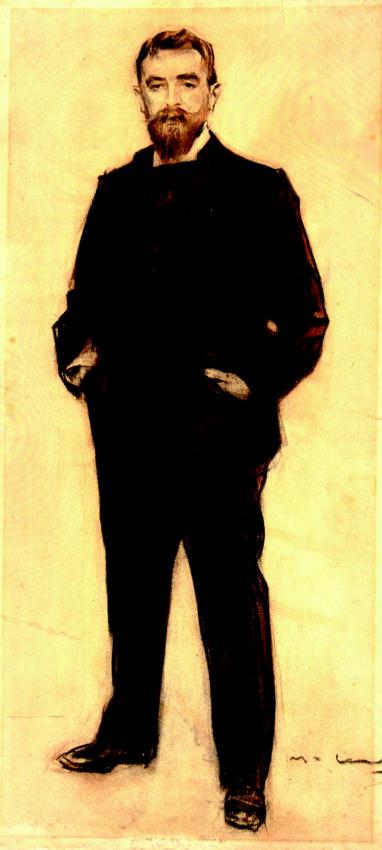
He is one of the most representative sculptors of Modernisme and worked on the movement's most significant buildings.
He began studying drawing with Josep Berga i Boix and sculpture at a workshop, El Arte Cristiano, run by the Vayreda brothers in Olot. Later, in 1888, he furthered his studies with a grant in Paris, where he was a student of Henri Chapu. His stay there led him to change his conception of sculpture under the influence of both Rodin and Meunier.
He exhibited for the first time in Barcelona in 1891, showing two small pieces, one of which, Flor boscana (Forest Flower, MNAC collection), already had certain Modernista features due to the smoothness of the modelling and the factions. One of his best-known works, Els primers freds (The First Cold Spells, 1892; MNAC collection), won the first medal at the Madrid exhibition of 1892. This work, from his formative period, displays detailed figure work in a narrative setting.
Shortly after this he went to Rome and his work became even more Symbolist. On returning in 1894 he set off again for Paris, where he intensified his activity, putting on individual exhibitions and winning medals in various competitions and exhibitions, such as the Universal Exhibition of 1900. A representative work from this more Symbolist period is Perseguint la il·lusió (Persuing Illusion, 1903; MNAC collection). In 1906 he went to live in Madrid for good. There he devoted himself to teaching and doing work for which he was commissioned, mainly monuments, something quite different from what he had done in Barcelona.
His artistic production, which began in a rather academic style, evolved towards Modernisme, a style which gained strength during his stay in Paris. Particularly outstanding among his work are the nude figures, with the realism of the flesh offset by the delicacy with which they are sculpted and surrounded by a melancholy air.
In 1907 he worked on the sculptural decoration of the Palau de la Música Catalana (1905; Palau de la Música, 4-6), designed by L. Domènech i Montaner, with the spectacular group La cançó popular (Popular Song) on the façade, the figures of which merge and meld with the building as a whole.
He was a member of the Real Academia de Bellas Artes de San Fernando in Madrid (San Fernando Royal Academy of Fine Arts) and, from 1925, director of the Spanish School in Rome. There are also some monuments of his in South America, such as the Monument to Manuel Moreno in Buenos Aires.
Principal works
Sorry for the inconvenience, but we do not have any work for this author.
Get the Guidebook of Barcelona Modernisme Route
The Barcelona Modernisme Route is an itinerary through the Barcelona of Gaudí, Domènech i Montaner and Puig i Cadafalch, who, together with other architects, made Barcelona the great capital of Catalan Art Nouveau. With this route you can discover impressive palaces, amazing houses, the temple that is symbol of the city and an immense hospital, as well as more popular and everyday works such as pharmacies, shops, shops, lanterns or banks. Modernisme works that show that Art Nouveau took root in Barcelona and even today is still a living art, a lived art.
The Guidebook of Barcelona Modernisme Route can be acquired in our centers of Modernisme.