

Víctor Beltrí i Roqueta
Tortosa (Tarragona) (1862) - Cartagena (Murcia) (1935)
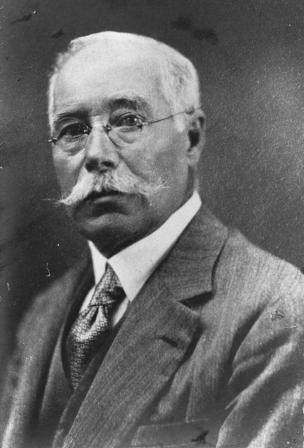
Although he was born into a poor family, the intellectual atmosphere in his home had a decisive influence to make him move to Barcelona to take Architecture Studies. In order to pay his studies, he worked with his professor Augusto Font. During these years as a student, he meets Gaudi, with whom he even works on some ocassion.
After working in Tortosa (1887-1890) and Gandía (1891-1893) as a council architect, he moves to Murcia, to work as an architect for the Treasury (1893-1897).
In 1895 he gets to Cartagena, which, at that time, was a city with a booming economy due to the mine industry. It is in this city where he made the best of his production for that new mine bourgeoisie, highlighting, among many other modernist works, the Cervantes House (1897), the Casino (1897), the Aguirre Palace (1898), the former Beltrí House (1904) , the Barthe Building (1906), the Alessón Building (1906), the Maestre House (1906), in collaboration with Marceliano Coquillat, the Pantheon of Aguirre (1906), the Dorda House (1908), the Zapata House (1909), the disappeared Real Club de Regatas (1911), the Grand Hotel (1912), the unique Llagostera House (1913), with a fantastic ceramic tile facade work by Gaspar Polo, the Children's House (1917), the Huerto de las Bolas (1918) and the Pantheon of Celestino Martinez (1921). We also have to mention other notable modersnist works done outside Cartagena, such as the Food Market (1901) and the Pantheon of the Salmerón Brothers (1905), both in the city of of La Unión (Murcia), or the Paris Palace (1908) in Gandía.
Architecturally speaking, he initially opted for an eclectic style, to quickly develop into a modernist style in which he incorporates elements of Catalan, French, Belgian and Viennese schools. He stresses the overall concept of the buildings, getting into his works the seamless integration of all the applied arts, in the purest modernist spirit. With Beltrí, we face the best representative of this trend in the Región de Murcia
Principal works
Sorry for the inconvenience, but we do not have any work for this author.
Get the Guidebook of Barcelona Modernisme Route
The Barcelona Modernisme Route is an itinerary through the Barcelona of Gaudí, Domènech i Montaner and Puig i Cadafalch, who, together with other architects, made Barcelona the great capital of Catalan Art Nouveau. With this route you can discover impressive palaces, amazing houses, the temple that is symbol of the city and an immense hospital, as well as more popular and everyday works such as pharmacies, shops, shops, lanterns or banks. Modernisme works that show that Art Nouveau took root in Barcelona and even today is still a living art, a lived art.
The Guidebook of Barcelona Modernisme Route can be acquired in our centers of Modernisme.