

Xavier Gosé i Rovira
Alcalá de Henares, central Spain (1876) - Lleida (1915)
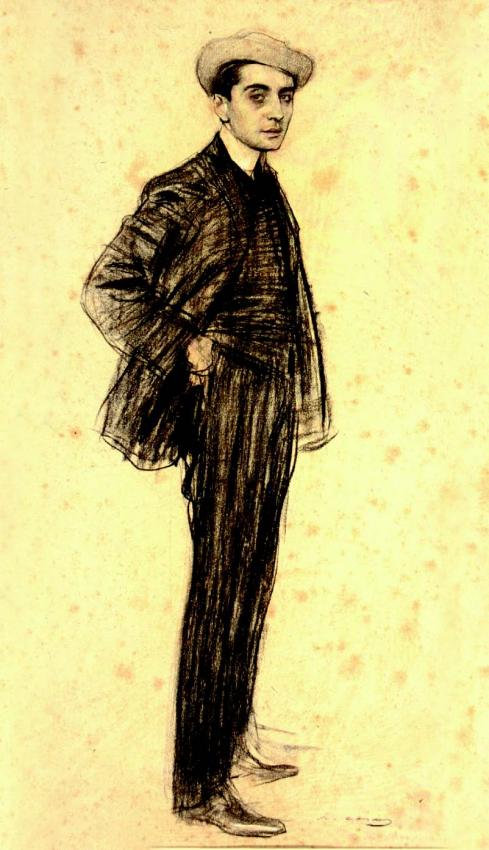
He moved to Barcelona at a young age and studied at La Llotja, the Barcelona School of Fine Arts, while also training with the realist sketcher Josep Lluís Pellicer.
He stood out for his skill at line work and stroke work, and soon evolved towards Modernisme, seen in the Japonism in his compositions, his use of colour and the use of the wavy line "whiplash" motif. He started out working as an illustrator for various weekly magazines such as L'Esquella de la Torratxa, Quatre Gats and La Saeta.
In 1900 he left for Paris, where, after a difficult initial period in which he had to confine himself to drawing essentially the "flamenco dancer" theme, he gradually began to specialise in humorous cartoons and achieved much success with his renderings of bohemian Paris. While still working as a cartoonist, he also employed the same style in his posters. He gradually began to contribute to top rank French magazines such as Le Rire and Le Témoin, and leading German magazines. He returned to Barcelona for brief periods to exhibit at Sala Parés (Petritxol, 5).
In 1912, at the end of his career, he turned to fashion and his drawings moved away from the Modernista style, becoming more geometrical and stylised.
Principal works
Sorry for the inconvenience, but we do not have any work for this author.
Get the Guidebook of Barcelona Modernisme Route
The Barcelona Modernisme Route is an itinerary through the Barcelona of Gaudí, Domènech i Montaner and Puig i Cadafalch, who, together with other architects, made Barcelona the great capital of Catalan Art Nouveau. With this route you can discover impressive palaces, amazing houses, the temple that is symbol of the city and an immense hospital, as well as more popular and everyday works such as pharmacies, shops, shops, lanterns or banks. Modernisme works that show that Art Nouveau took root in Barcelona and even today is still a living art, a lived art.
The Guidebook of Barcelona Modernisme Route can be acquired in our centers of Modernisme.