

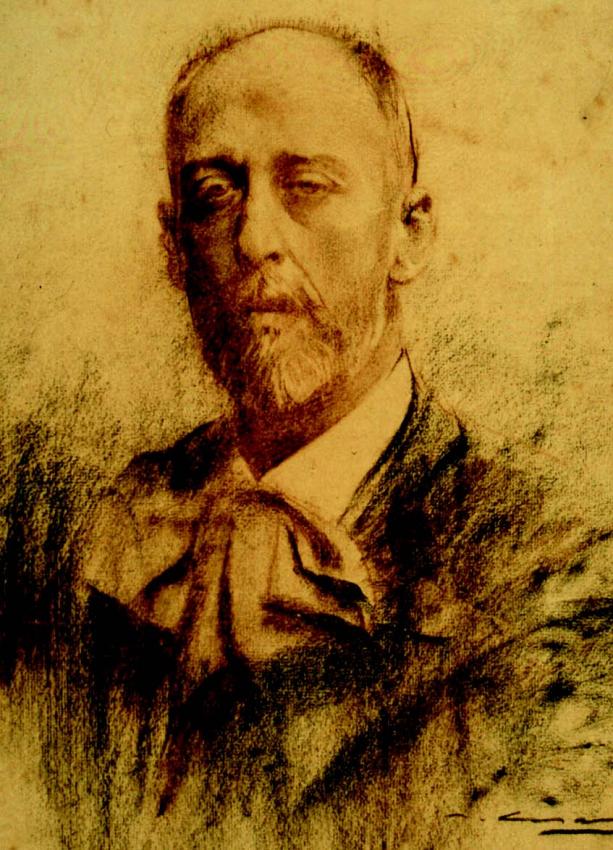
Having trained at La Llotja, the Barcelona School of Fine Arts, and in the workshop of Marià Carreras, he went to Paris to further his knowledge and for a time, between 1862 and 1869, worked in Charles Antoine Cambon's workshop in charge of the perspective side. He later became manager of the workshop belonging to Joseph Thierry, a renowned French stage designer.
He renovated Catalan stage design, mainly from a technical rather than a formal point of view, as it was still very much tied to the Vuitcentista realist tradition (Escenografia de Tristany i Isolda [Set for Tristan and Isolde], for the Gran Teatre del Liceu, 1899; Barcelona Theatre Institute). Nevertheless, he did introduce the concept of depth into scenery and so helped to promote a new school. Other stage designers such as M. Vilomara trained and worked with him, and many other artists were taught by him at La Llotja.
His workshop also designed interior decorations on which many of his students, such as O. Junyent, S. Alarma and the mosaicist L. Bru, collaborated.
Principal works
Sorry for the inconvenience, but we do not have any work for this author.
Get the Guidebook of Barcelona Modernisme Route
The Barcelona Modernisme Route is an itinerary through the Barcelona of Gaudí, Domènech i Montaner and Puig i Cadafalch, who, together with other architects, made Barcelona the great capital of Catalan Art Nouveau. With this route you can discover impressive palaces, amazing houses, the temple that is symbol of the city and an immense hospital, as well as more popular and everyday works such as pharmacies, shops, shops, lanterns or banks. Modernisme works that show that Art Nouveau took root in Barcelona and even today is still a living art, a lived art.
The Guidebook of Barcelona Modernisme Route can be acquired in our centers of Modernisme.