

Lluís Bru i Salelles
Ondara (1868) - Barcelona (1952)
His first experience in the world of art was in the realm of stage design where he started out working as a pupil of F. Soler i Rovirosa and M. Vilomara. He eventually became a regular collaborator of the latter and they worked together on many sets for the Gran Teatre del Liceu (Rambla, 51-59) around 1901.
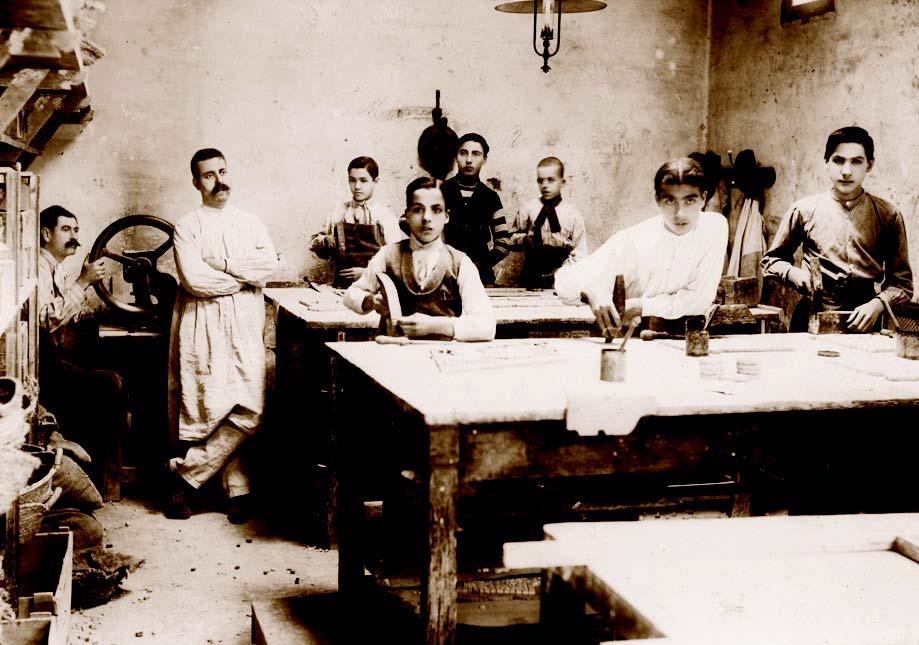
Encouraged by the architect L. Domènech i Montaner, he became interested in mosaics and spent some time in Venice to further his education and learn this technique which he was to apply to his work upon his return. In 1904 he opened a workshop in Carrer d'Enric Granados in Barcelona. The mosaics produced in his workshop include those of the Hospital de la Santa Creu i Sant Pau (1902-1930; Sant Antoni Maria Claret, 167), Casa Lleó Morera (1905; Passeig de Gràcia, 35) and the Palau de la Música Catalana (1905-1908; Palau de la Música, 4-6), all buildings designed by the architect L. Domènech i Montaner. He also produced mosaics under the direction of other architects, such as those in the former Casa Teixidor (1909; Ronda de Sant Pere, 16; now the Arense optician's), designed by the architect M. Raspall, and those of Casa Comalat (1909-1911; Còrsega, 442), a building by the architect S. Pupurull.
He also stood out as a painter and designer in the decorative arts. Of particular note is the work he did for the Pujol i Bausis factory in Esplugues de Llobregat (Passatge Puig d'Ossa, s/n) for which he designed various made-to-order skirting boards and tiles.
Another example of his work in Barcelona are the paintings he did for the Bolós chemist's shop (1904; Rambla de Catalunya, 77) together with Maurici Gelabert.
Principal works
Sorry for the inconvenience, but we do not have any work for this author.
Get the Guidebook of Barcelona Modernisme Route
The Barcelona Modernisme Route is an itinerary through the Barcelona of Gaudí, Domènech i Montaner and Puig i Cadafalch, who, together with other architects, made Barcelona the great capital of Catalan Art Nouveau. With this route you can discover impressive palaces, amazing houses, the temple that is symbol of the city and an immense hospital, as well as more popular and everyday works such as pharmacies, shops, shops, lanterns or banks. Modernisme works that show that Art Nouveau took root in Barcelona and even today is still a living art, a lived art.
The Guidebook of Barcelona Modernisme Route can be acquired in our centers of Modernisme.